

The Global Tax Expenditures Database is an intriguing resource that shows how governments around the world use preferential tax treatments to promote different policy goals. It is designed to increase transparency around tax expenditures and create new opportunities for analysis.
All data is at the national level – it does not include state and local tax expenditures. I’m still learning how best to use it, but the following figures derived from the database show its potential for understanding competitive and policy differences across countries. Users can compare spending on economic development policy goals such as investment promotion, developing specific economic sectors, helping people and places, and promoting environmental sustainability, among others.
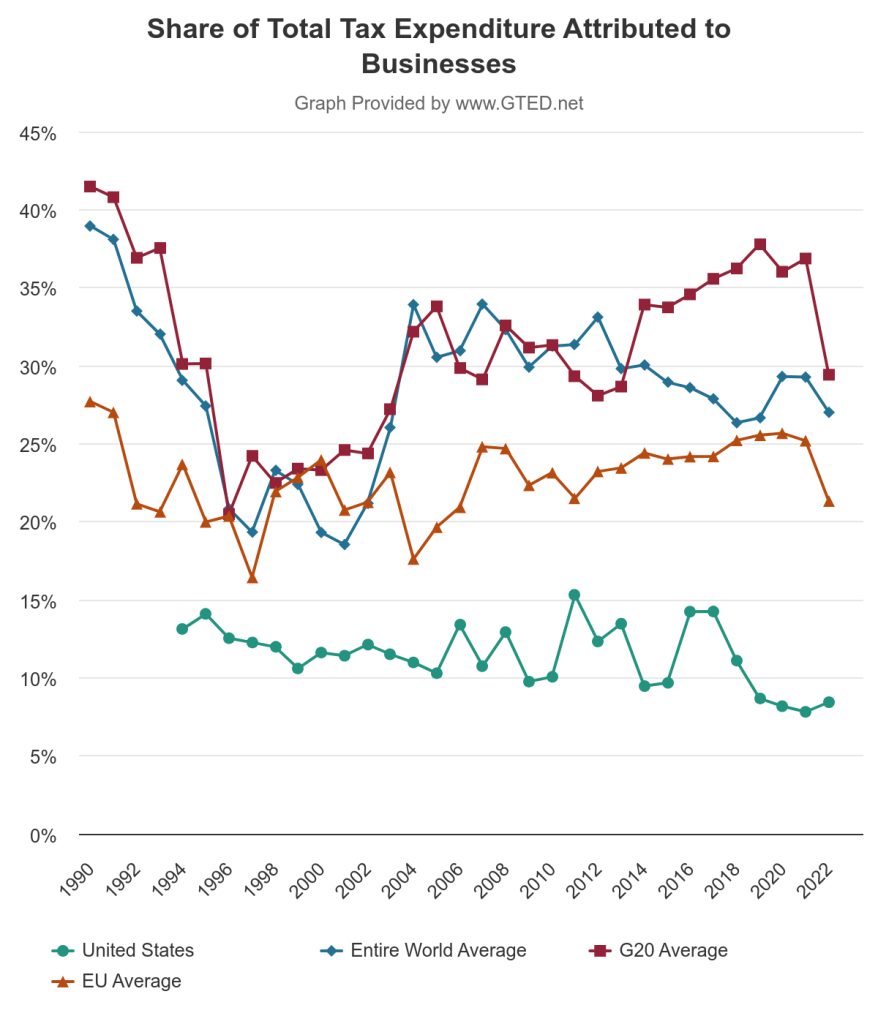
To start, the first chart below summarizes the percentage of tax expenditures that go to businesses, as opposed to households or other beneficiaries. US businesses are the intended beneficiary for a much smaller percentage of total tax expenditures than in the rest of the world.
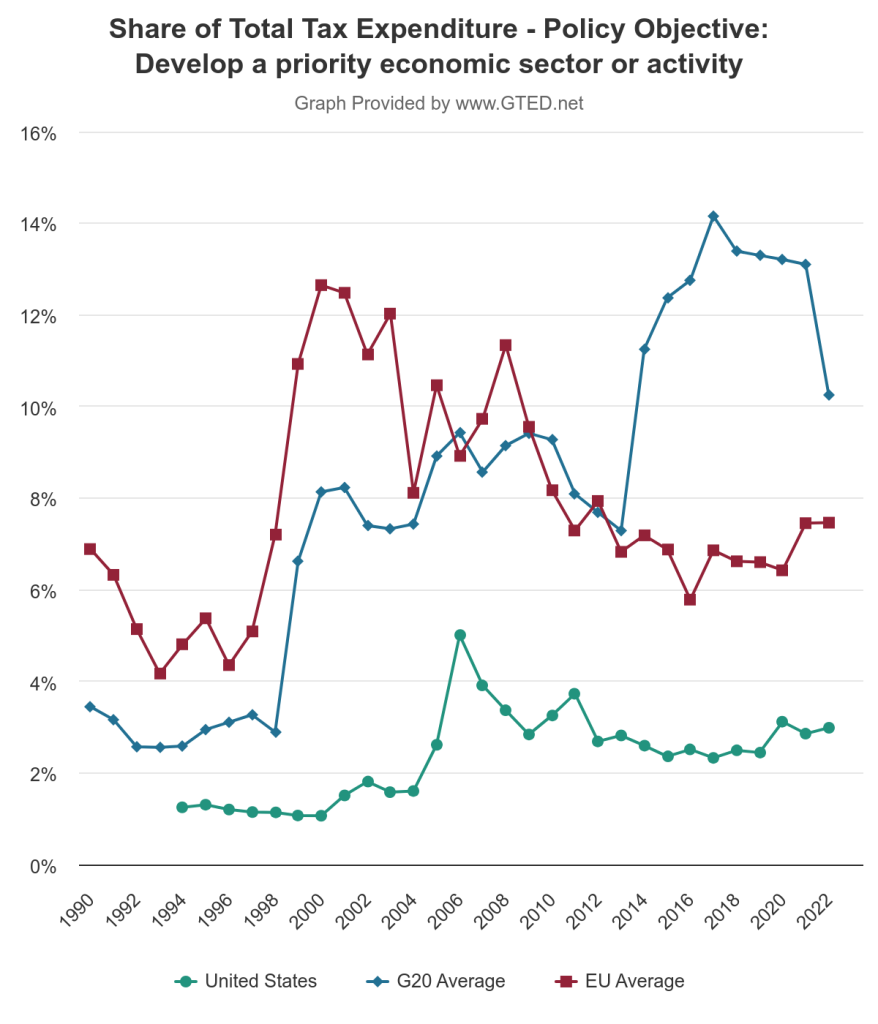
As a nation, the US does not even show up in terms of the share of total tax expenditures devoted to attracting and promoting investment since most of that work occurs at the state and local levels. But, also, a smaller share of tax expenditures in the US is used to develop a priority sector or activity when compared to the G20 or European Union (EU) averages.
One exception is the energy sector, where the US exceeds the G20 and EU levels.

The database itself is easy to use. Data can be examined by tax type, beneficiaries, policy objective, and tax expenditure type. Figures can be compared across countries, regions, and several other geographic configurations.
Country-specific summaries are also available. At the national level in the US in 2022, tax expenditures accounted for $1.46 trillion in total revenue foregone or 5.75% of GDP. The data can be downloaded or visualized as revenue foregone as a percentage of GDP or as a percentage of tax revenue or by local currency. You can also see the number of beneficiaries. Useful summary figures are available in the dataset, such as the ten largest tax expenditures by country.
To learn more, go to https://gted.taxexpenditures.org
Redonda, A., von Haldenwang, C., & Aliu, F. (2024). Global Tax Expenditures Database [data set], Version 1.2.2. https://doi.org/10.5281/zenodo.10796848
Recent Comments